
Notes of many things: Best of recent notes

Cringe
I think it’s good that No Kings is cringe. I think nothing in this world that is truly good can be anything other than cringe. Of course, I have a lot of criticisms of No Kings, but being cringe isn’t among them. Nothing that is uncringe will see the light of heaven, and since all souls will see the light of heaven, all souls will have to be made cringe.
Parasocial
I think part of what many people are missing about the assassination of Kirk is the parasocial angle. To the best of my knowledge, this is the first time a truly major parasocial figure has been assassinated in an Anglophone country.
Don’t get me wrong, there have been numerous celebrities assassinated - but they weren’t parasocial figures. There wasn’t a TV channel you could turn on and listen to John Lennon yattering with three of his friends about the news of the week. Very few people felt like, deep in their limbic system, John Lennon was actually their friend whom they hung out with regularly.
During the pandemic, I listened to a fair bit of Chapo Trap House. Embarrassing though it is to say, during lockdown, I had a reasonably strong parasocial attachment there. Now I think Felix Biederman is a great guy and a brilliant mind with a heart of gold, but during that period, I genuinely think that if something had happened to him, it would have felt like something happening to a close friend. If, God forbid, Felix were assassinated, it would have felt like a political assassination of a childhood friend. Rationally, I’d know that wasn’t the case, but that’s what the deep parts of my brain would be screaming.
Now multiply that by millions of people, and you see why parts of the right are currently melting down and overplaying their hand. To be sure, a lot of the actors involved are absolutely cynical and see it as their Reichstag fire moment (some big rightwing account literally called it a Reichstag fire moment). But the frantic core of momentum started with people’s brains telling them that a personal close friend of theirs had just been assassinated because people didn’t like the contents of the little chats he’d been having with you.
The left doesn’t want to talk about it this way, because it makes the right sound too sympathetic, and the right doesn’t want to talk about it this way because it makes them sound too pathetic, but this is part of what’s fueling the fire.
Civilization
Civilization is, in part, a situation where you accept that sometimes the bad guys might win, because they have more options than you, but hope to control them by force of numbers.
Allow me to illustrate. Every so often, some gun nut will shoot someone who was unarmed and not apparently constituting a threat. E.g., this case where a guy rang the wrong doorbell:
Or this case where a woman pulled into the wrong driveway:
Or this case:
A lot of wrongful killings by cops also look like this, a cop refusing to accept that in order to stay within the dictates of morality, they need to accept a non-zero risk of dying e.g.:
or the shooting of Daniel Shaver
https://en.wikipedia.org/wiki/Shooting_of_Daniel_Shaver
Most people, even kinda nutty people, will accept that shooting someone ringing your doorbell was a lunatic thing to do. Every so often, though, someone will try to defend it. “He had to shoot first. What if the guy had had a gun! You can’t let someone get the drop on you.”
The answer of course is that the homeowner would have likely died. C’est la vie. Hopefully, afterwards, the killer would have been caught. That’s just the way it goes. But the fact that someone might have a gun and be planning to kill you is no excuse to strike first.
Unfortunately, you just have to accept the risk of dying, rather than shoot at a person you have no proof isn’t innocent and harmless. If we don’t do this, civilization collapses. The bad guy has more options, he can just do things- he’s not constrained by morality. It feels so righteous to dispute this- the good man should always be able to defend himself! Being bad should never give you a tactical advantage! But you’re actually throwing the civilizational structure that makes goodness possible away.
I’m convinced, but I cannot prove, that if you take this principle, add a little metaphor and extend it a bit, you get to the root of a lot of social issues. People just can’t bring themselves to accept that civilization means recognising that you shouldn’t always try to beat the bad guys at their own game. We shouldn’t tear down or system of rights and peace in order to create a fantasy world in which bad people never get the drop on us, literally or symbolically. Even the lex talonis [an eye for an eye, a life for a life], now widely seen as too harsh, is based in this recognition- specifically the recognition that you should never escalate first- you should leave that ‘privilege’ to the bad guys.
Civilization
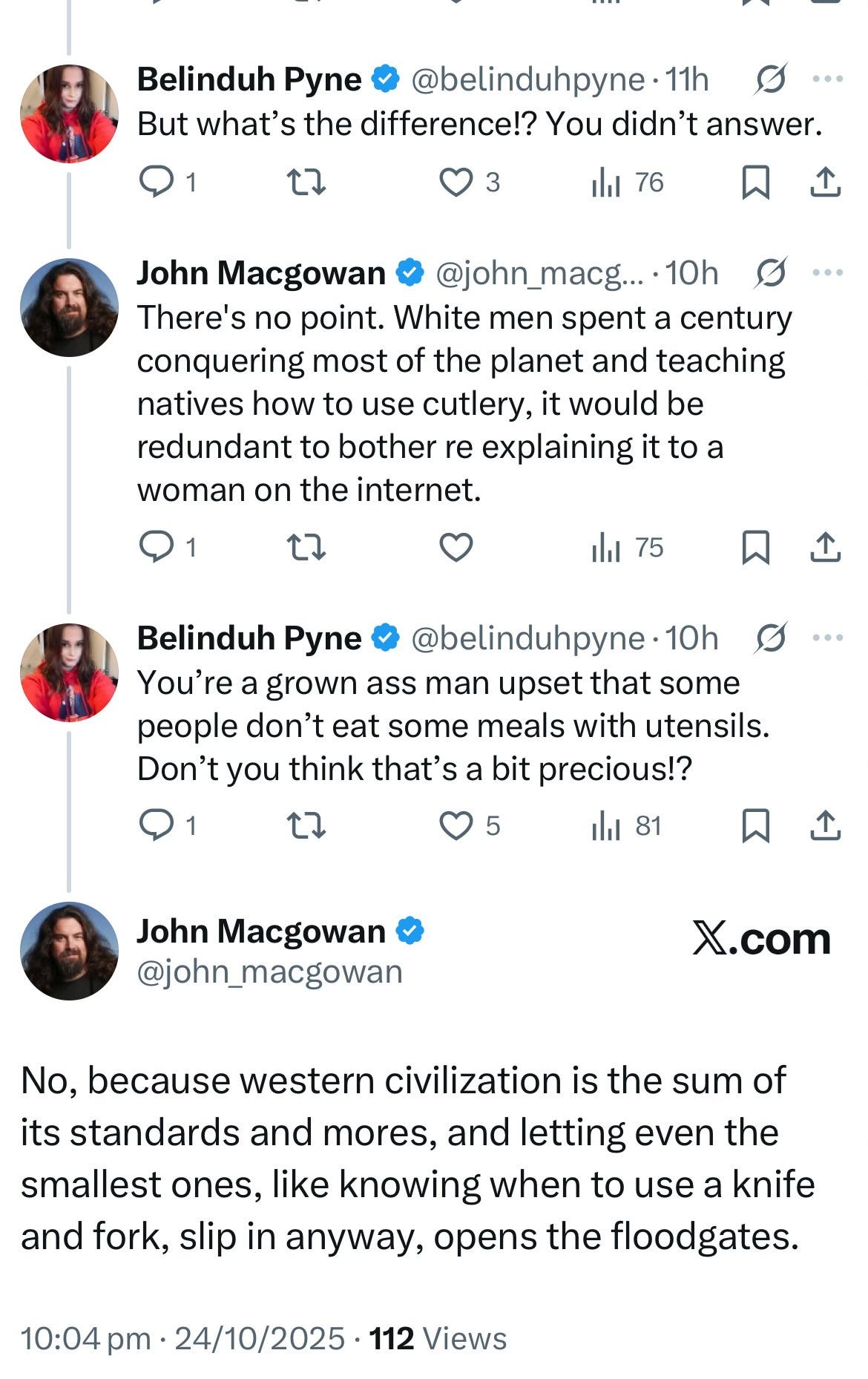
I think there’s a real existential horror to believing that civilization is about cutlery, like living in a spirit-haunted world and thinking that if you change any aspects of your behaviour, demons will invade your life.
I suppose, though, that when, as the right does, you tend to admire the very things that destroy civilization - violence outside strict controls - yet claim you want to defend Western civilization, the only way to square this is to identify civilization with the trappings of civilization.
No advantage
An all-pervasive feature of modern society is that it is extremely difficult to gain an advantage. Call it the no-advantage property.
You can’t beat the stockmarket because of the EMH- if a particular stock were worth more than its current price, and this could be known through publicly available information and normal methods, this would already be reflected in its price.
You can’t beat the job market. If there were an easily available route to a good job, everyone would take it till there were no more jobs left.
Even something like restaurants displays the phenomenon to a degree. If a particular restaurant is widely known to be of superb quality, this will soon be reflected in its prices and/or queues.
If there were some dating strategy to pick up all the handsome gents or ladies that anyone could do, everyone would have already done it, and there would be no handsome gents or beautiful ladies left for the taking.
Astonishingly, as far as I can tell, there is no general term for the phenomenon in the research literature. There are ways around it [although the sharemarket case in particular is very tough]. For example, you might just notice something that not many other people have noticed yet. Or you might have a unique bundle of endowments, talents, or preferences that set you up to get an opportunity that either wouldn’t be possible for, or wouldn’t appeal to, many people (this is what we’re all trying vis-à-vis the job market). Or you might just be lucky.
The no-advantage property has doubtless been present as long as there have been organisms, but it becomes particularly acute in a large society. I think it drives people insane. It makes people think the world is malicious- that some force or power is plotting against them. It makes people turn to scams and superstitions.
It is particularly maddening, because in many cases, all that stands between us and gaining advantage is a tiny bit of knowledge- a bit of knowledge that we might conceivably happen upon. A bit of knowledge we could fit on a small napkin. A bit of knowledge we will one day know- that will seem so obvious in hindsight. It feels like the world is playing games with us.
Uncomfortable
We detest no one so much as the man who has our same social vices, but just a little bit worse.
Hard truths
If you are straight and you don’t like the opposite gender, you’re going to have a bad time.
Belief
ChatGPT just made a point to me that I’d never considered before, but in hindsight seems obvious:
People like to feel believed, and people like to believe their friends. Not being believed hurts, and not believing can feel like a kind of betrayal. Of course, I already knew that but…
This is how part of how superstition and new religions propogate. One person starts believing something, his or her friends feel obliged to believe- not just because they want to copy their friend- standard stuff- but also because they don’t want to betray their friend and alienate the friendship by disbelieving.
My believing X puts you on the spot. Accept it, or wound be through disbelief.
PUNISHMENT
This is my intuitive model of society, vis-à-vis contemporary politics. I don’t think it’s true exactly, but it works like this in my mind.
A political coalition, at least in the current period, is essentially a coalition to punish one or more groups. There has been sin, and thus there must be punishment.
Some stuff doesn’t just doesn’t seem right. An easy way to trigger this sense is inflation, unemployment, and/or inadequate wage growth. Crime stories trigger it. Generic “political chaos” triggers, and so on and so forth. A sense of angry-wrongness accumulates. Call this sense PUNISHMENT ENERGY.
Stuff happens when punishment energy builds up and then eventually discharges against someone. While punishment energy can have a natural directionality- in perceived crime glut it is naturally directed against criminals, for example- a skilled politician can redirect it almost any way. PUNISHMENT ENERGY is usually first and foremost non-specific; any specific identity it has is of secondary importance.
There are two main groups that the mass of society can discharge PUNISHMENT ENERGY against- those stronger than them and those weaker than them. Classically, the left wants to discharge the punishment energy against the rich, etc., whereas the right wants to discharge the punishment energy against immigrants, criminals, and BENEFIT SCROUNGERS etc. Essentially in one form or another both sides want to the bad people who are not like us have stop the markets working justly and have made everything mean and unpleasant, more or less through conscious antipathy to the good. But those people could be FAT CATS or they could be the homeless- the average person carries a fair bit of antipathy towards both.
Only it’s actually quite difficult to form a coherent, permanent formation that aims to discharge PUNISHMENT ENERGY against the strong. That’s almost a tautology- if they weren’t hard to punish, they wouldn’t be strong. Thus, post about 1973’, the mainstream left, such as it is, tries to hedge things- discharge a little punishment energy against the strong, discharge some against the poor, waffle a bit, and just leave the punishment energy untapped. This causes them lots of electoral problems.
But the punishment energy is building. Because the center cannot discharge it, they cannot tap this political moment. They are at risk of being hit with a large burst of PUNISHMENT ENERGY themselves.
The whole doctrine of the center is “things can get better for everyone at the same time- a rising tide floats all boats” this is precisely the wrong message for this moment. What works is zero-sum politics- it’s just a question of who is identified as the outgroup. Nor will straddling the center work. If I am right, both the left and the right should be doing better than the center in many places, and I think this is exactly what is happening.
A lot of voters, perhaps surprisingly, are open to either a left-wing or a rightwing PUNISHMENT ENERGY discharge. This is why, for example, figures like Sanders are often surprisingly popular with the right. Many voters aren’t so much left or right as pro-punishment.
The only humane way to discharge PUNISHMENT ENERGY is against the rich. For one thing, it generally won’t kill them. Hence, I support the left, and despite my own technocratic sensibilities, support a high degree of populism.
Is the above story true? No. Obviously people care about things other than punishment. Punishing the wealthy was, for example, a relatively subdued theme of Zohran’s recent campaign in New York. But it is often close, sometimes startlingly close, to the truth.
Believe
You should believe the following things, as tightly as you can, despite them being very close to contradiction.
The democratic public is good. Apparent evils from the democratic public are like the tsar and his advisors- all evils are from the wicked advisors, all good is from the people. Nor is any large segment of the people evil, even the ones people target like white men and people over 65, whatever, wicked. The people are good; they have been misled by their wicked advisors.
There are dark forces in the public consciousness as well as segments of the elite class; if these gain control, things could be far, far worse than we imagine. It’s a popular leftism to reject the idea of descent into hell: “we are already in hell” and there’s a lot of truth to this- so much avoidable pain, death, and hate, but things can get so much worse, hundreds of millions could die.
The first point is in no sense empirically true. You can very easily set up a bar- a very reasonable bar- according to which most people are evil. But you shouldn’t. You must affirm, however absurd it may seem, that the Czar/People are good but they have been mislead by their wicked advisors.
Wisely directed fear
You’re all wrong about dating.
Or at least the stuff I keep seeing is. Everyone seems obsessed with not ending up with someone who cheats on them. Your top fears vis-à-vis personal traits, in this order, should be:
1. Ending up with someone who screams at you, might grow to hate you, or hits you. In a phrase, various aggression traits. Please note this applies to both men and women. Women have more to fear from physical abuse than men, but things won’t be a bed of roses for a man or woman who is actively disliked by their spouse, or who faces explosive outbursts.
2. Ending up with someone who, through laziness or excessive spending or both, bankrupts you or causes serious financial problems.
3. Ending up with someone with different preferences on having kids to you, especially if they’re prone to not respecting prior agreements.
4. Infidelity.
Infidelity is somewhat less common than people think, but even more importantly, it’s hard to do anything about it. It’s edged out for third place by different kid preferences because, beyond the obvious things, it’s very hard to screen for infidelity in advance compared to the others, so worrying about it won’t get you far.
An example: Some people think it’s a red flag when a prospective partner is friends with their exes; I think it’s a green flag. It signals low cluster B traits, reducing the likelihood of 1.
People on social media who go big worry most about infidelity and far less about 1. This is, in part, I think, because the typical person on social media who makes it big, and the typical tenor of posts, is itself pretty cluster B. Full of narcissistic, borderline, and even antisocial traits.
Saying it right
I love songs that refer to “knowing the right words” (e.g. “Blow up the pokies”). I am filled with the maddening conviction, always, that there is something I could say which would fix it all. This conviction has persisted in me since I was very young, I think. It is not an egocentric feeling- not quite, because there is nothing peculiar about me- I think there is something just about anyone could say which would heal the world. By these and these words, death, hate, ignorance, and pain were defeated.
Flipping and reflipping outcomes
The treatment of people with psychosis looks like an interesting case of something a tiny bit like technological reswitching:
At first, those with psychosis just wander the streets if not cared for by their families.
Then, as society gets more technically advanced and thus richer, it finds it affordable and prudent to create asylums to get psychotic people out of the public eye.
Then, through technological advances, anti-psychotics were invented. This changes the cost-benefit calculation. It becomes preferable to give psychotic people anti-psychotics and let them live outside. Of course, there are downsides; the anti-psychotics aren’t always taken and don’t always work, but the costs of asylums are high, and so people move away from them.
Then, as society gets even richer, the occasional encounter with a ranting homeless person rises up the list of remaining material discomforts, so the idea of paying to make it go away once again becomes tempting. We haven’t quite implemented 4 yet, but this seems to be the direction many are shifting in, judging by rhetoric about the homeless.
To be clear, I am in no way endorsing this way of looking at things; in fact, I think it’s an indictment of society that this is how we have set our priorities. But in political economic terms, this is roughly what I think has happened.
Personality types as Tit for Tat strategies
Prisoners’ Dilemma strategies as personality archetypes:
Mellow: Always cooperate.
Can reflect either a selfish calculation that punishment just on the whole isn’t worth it,
Or a commitment to something like genuine “pacifism”
Stick-up-for-self: Punish others to the degree that doing so is rational for your own well-being. Non-altruistic punishment. Tit-for-Tat can be seen as an attempt at this.
When your reputation becomes a concern, and you want to deter others, this can turn into one of the vindictive strategies below
Vindictive: Punish others beyond what is necessary - either out of altruism, or because you want to give yourself a reputation as someone not to be crossed.
“Moderate” variant- punish others until they have no longer gained an advantage over you by defecting.
“Unreasonable” variant- Never cooperate with someone again once they defect, or at least punish them many times before doing so.
“Mid-ground” variant- Punish others until they have no longer gained an advantage over you by defecting, plus a little extra punishment to make sure they’re properly deterred- useful if you want to enforce norms, but you don’t trust others to do so consistently, thus you add some extra badness to make up for the inconsistency.
Variant to the Stick-Up-For-Self strategy- forgiver. Retaliate, but occasionally don’t retaliate in order to try “calling off the feud” to see if it’s reciprocated.
Extorter: try to squeeze an advantage out of your opponents through defecting sometimes and cooperating sometimes. See “extortionary” strategies here for details: plato.stanford.edu/entr…
Exploiter: Start the game by figuring out someone’s personality, and if you find they’re mellow, exploit them; otherwise, try a different strategy.
Defector: Always defect. Perhaps because you think people are gullible enough, or uninformed enough, to know your reputation.
Erratic: Cooperation or defection not picked through any of the above considerations, but randomly. Conditions that grossly distort your perception of social reality may lead to this, in effect.
Chameleon- observe what strategies are dominant in the local population and select your strategy accordingly.
Autism

The latest wave of autism discourse is unproductive.
There are some people who suffer enormously and have severely reduced capacities due to what we call “autism.”
There are other people who have autism and live great lives. Some of them may even be better off with the autism and may think, quite reasonably, that their condition is not well described as a disability.
And there are numerous cases in between.
We need to acknowledge the reality of the first category because their support is urgent. But what about the second category- shouldn’t they just stop being called autistic? No. We need to acknowledge the second category, because there are things we can do, in light of their condition, to make their lives go better for them. Even if someone’s living a great life, it might still be important, for example, that people understand that when they don’t look you in the eyes, it’s not a sign of rudeness. Likewise, with recognition of problems like difficulty in fine motor control.
I get that people are frustrated that the first group gets almost no airtime, but pretending that the second group doesn’t exist, or isn’t well categorised as autistic, is not an appropriate response to that. They’re appropriately classified as autistic for two reasons:
They have a cluster of behavioural features which clearly overlap with and blend into the features, in a spectrum, of those worse off. AND
Once again, acknowledging their condition can lead to adjustments that make things go better for them and others. That is, the diagnostic category is useful for both the diagnosed and for society. This is still true even if, in an overall sense, they are not disabled.
Even more obviously, any suggestion that we should pretend autism can’t be a living hell in order to reduce ‘stigma’ is bollocks.
Maybe one day we’ll split autism apart into multiple conditions again- maybe we should do that- but for the moment, we must acknowledge complexity. For some people, autism is hell, for others it is just a way of being, and for some it probably really is a ‘superpower’. Our culture finds even this level of nuance intolerable, but that’s tough, deal.
Misandry
A lot of people complain of misandry from the left- and it’s true- there is quite a bit, and it’s a shame. What a lot of people miss is that the right are misandrists- probably more so than the left. See the following talking points from the right:
Men can’t help it. They’re just like it- women need to step up and take control of men’s sexuality, or else they’ll be the ruin of countless wome,n and it will be the women’s fault because men can’t be expected to take responsibility for their sexual behaviour.
If a 15-64-year-old man dies in a war, it’s safe to assume he was a fighter.
Men of fighting age aren’t allowed to be refugees- never mind the details of their lives and stories- they have to stay and fight.
If a man is a househusband, he’s emasculated and probably lazy.
Men with depression are wasting everyone’s time and need to toughen up. Jokes about prison rape.
Even much of the right’s hatred of trans women comes from misandry- from a sense that men in general are born with The Bad Seed, and so must remain visibly men for the purposes of surveillance lest they harm women.
It is no coincidence that among feminists who have thrown in their lot with the right, many come from the most men-skeptical factions among feminists. The right will always be big misandrists because at base, they’re misanthropes.
Socialising
When you realise that a lot of what you thought was people snubbing you because they are too cool is actually them snubbing you because they’re socially awkward and shy, your life improves enormously
Heterosexuals
The phenomenon of extremely heterosexual men is very interesting and much misunderstood. No one understands it more than straight men in general- many of those the typical straight man might think of as very heterosexual are not particularly heterosexual at all, indeed, some are actually bisexual. The “man’s man” who says “screw this” and gets a Grindr account isn’t just a gay fantasy- they’re quite real. The extremely heterosexual man, on the other hand, isn’t a man’s man- he’s a lady’s man.
Ironically, there’s a good chance he was mistaken for gay in high school. Effeminate? That’s not quite right. Some are effeminate, whereas some are quite butch- what unites their gender presentation isn’t effeminacy or masculinity, it’s a certain fruitiness. The Victorians understood the phenomenon well when they talked about the dandy, who was a threat to the virtue of women. They’re the guy who, if you get him drunk (and maybe even if you don’t) will wax rhapsodically about how much he loves giving cunnilingus. They generally really like women, including outside of a sexual context - while there’s plenty of room to fault how he sees women, he’s no misogynist. He doesn’t say stuff like “women, who gets em’” because he has a pretty good working understanding of women. You might want to settle down with him, and doubtless this happens sometimes, but the problem is that he has so much love that he wants to give to women that getting him to stick to one can be a problem.
Women- more than ever- are onto him. He is often the one complained about when people talk about performative men, softboys, and, in many cases, male feminists. If heterosexuality is a specifically male desire to have sex with and romance women, then this fellow is heterosexuality at maximum. He’s definitely a man, and boy does he ever want to have sex with women because they are gorgeous and soft and wonderful and there are so many of them.
Sufjan
I have been listening to Sufjan Stevens for many years. What I have finally learned, I think, is that there is no shortcut into a soul. I know so much about Sufjan the artist, and so little about him.I would learn more about him in an hour-long conversation than I have ever gleaned from dozens and dozens of songs through which he tries to represent his most intimate moments. Perhaps some god like computer could reconstruct his soul out of his lyrics, but not me. Ironically, the only time when I ever felt like I had locked gazes with him mentally was the last lines of Eugene:
What’s the point of singing songs
If they’ll never even hear you?
It makes me afraid. What if “I” am a lie I have constructed to make myself legible enough to sell essays? Does it matter on some ultimate ledger?
AI victims
I believe that a lot of ways people get fucked over by AI- enraptured by sychophancy, one-shotted into thinking they have a brilliant idea, fooled by hallucinations that are presented so confidently- reflect weaknesses we have in relation to other people too. If you keep getting fooled by hallucinations, you probably also believe a lot of bullshit that people have told you over the years that you should have picked up on. Getting good at not being led by the nose by AI- while still knowing when it’s right and you’re wrong and learning to resist flattery, etc- all these skills will serve you well in ‘real life.’
Tragedy
People who laud the tragic quality of human life often miss that it’s not a tragedy unless someone is trying to stop it. Any tragic beauty of human existence depends on our trying to make human existence better.
Keeping it together?
A big concern about the internet is that people who are so, for want of a better phrase, cluster B, that they could not function in the real world, can accumulate social capital online. Obviously, there are incredibly narcissistic, unstable, aggressive, etc., etc. people who amass great power in real life, but the ones who couldn’t “keep it together” are sometimes at least cut out. Not in an organised way- not in a just way- with numerous accidents and biases- but winnowed out nonetheless. That either doesn’t happen on the internet, or when it does happen, happens only after they’ve reached some prominence with a mighty and destructive boom.
Liberalism
One of my most unpopular beliefs is that:
There is such a thing as “substantive liberalism”, liberalism as an ethic.
Substantive liberalism tends to devour cultures from the inside, allowing them to keep their shape, but changing their core features into those of liberalism- universalism, tolerance, the reasonable, life choice at the individual level.
This is good. Substantive liberalism should devour everything. It’s not perfect; in particular, it needs to develop more in a communalist and solidaristic direction. Nevertheless, everything in the world must be hybridised with substantive liberalism.
Childlike- plus a taste of what’s coming
There’s a sense in which a well-ordered society makes people into children. A working justice system reduces the need to know how to defend yourself and the need to know who to trust. A social safety net means you don’t have to stay up at night planning contingencies and plotting the shoring up of your alliances and networks. National defence and disaster management mean you can live without an escape plan. All of this, in a few different senses, will tend to make you live and even think more like a child. Even economic prosperity increases the time you can pursue hobbies and friendships- basically, play. The holy grail of a post-scarcity society would, in many ways, make us all into permanent children.
Maybe there are senses in which this is somewhat regrettable. For example, I admire the ability to defend oneself. I admire the forms of resilience many people in less well-ordered societies have. However, only a calamitous fool, or a bilious villain, would think this is, all things considered, a reason to want a less well-ordered society. Unfortunately, there are quite a few calamitous fools and bilious villains.
Free speech
Been thinking about a few antinomies in free speech, specifically old debates about whether private violations of free speech are possible:
On the one hand, A strong case can be made that restricting the category of free speech violations to physical violence or government laws, as is traditional, is not expansive enough. A large mob of individuals, perhaps even assisted by the politicians, can act to render the legal right to free speech almost meaningless. One of the classic cases of free speech suppression in the history of America- McCarthyism- did use laws to achieve its ends (e.g., forced testimony), but could have, in principle, been done entirely through First Amendment-friendly means. Yet a country like this- with potentially near-totalitarian policing of speech through private means- cannot be said to in reality have free speech.
On the other hand, if private acts with a wide enough enough can be considered free speech violations, what is the remedy? The government punishing people for calling for a boycott, or publicly criticising someone, doesn’t sound like an attractive place to live!
The solution to the antinomy is to grant that some violations of free speech are real violations of free speech, but it is not appropriate for the government to remedy them, or at least it can only provide very partial remedies. It cannot forbid certain private violations of free speech because doing so would be an even larger violation of free speech. At best, it can only provide soft leadership against such practices, e.g., condemnations by officials and politicians of private censorship.
So far, we have a view of free speech on which the classic rule- no government regulation of speech- applies, and additionally, individuals face a somewhat unspecified set of restrictions on how they can restrict others’ speech- but these are only meant to be enforced privately, through norms of discursive culture, and not by government, because this would be a more severe breach of free speech.
There’s another interesting feature of the view I’ve described- it implies that exercises of the right of free speech can violate others’ free speech. That seems odd because it suggests that free speech might be a contradictory principle. Very roughly, we might resolve this tension somewhat along Rawlsian lines by suggesting that a moral right to free speech is the right to the highest range of freedom of speech, which is compatiable with everyone else having that same degree of free speech. But it seems there might be different configurations of the right which would meet this symmetry requirement. Worse, on some construals, this test might be undesirable- a charismatic person might simply have a way of speaking which seizes attention and gives them a larger voice. Depending on the details of the moral system and the exact way the expansiveness of rights is defined, this might give them a larger right to others, yet stamping this out seems likely to be undesirably oppressive and overbearing in practice.
Furthermore, maybe we don’t want to consider speech rights on their own, absent consideration of other rights and welfare, as something to be maximised at all costs. For example, the maximum possible degree of free speech for everyone might include a discursive culture that permits running a cruel and abusive commentary on someone’s life, but forbids organised retaliation (e.g., social ostracism) for running this commentary. Maybe even though this set of rules would maximise the amount of free speech available to everyone, it is, in an overall sense, a bad idea because of its effects on welfare, or perhaps other rights like autonomy.
I do think, though, that:
Private individuals can, in effect, violate the right of free speech, and not just through acts of physical violence.
The state should, in principle, oppose attempts to stifle many kinds of speech, but usually should not legislate against speech-stifling- private violations of free speech are real but usually don’t have legal remedies [there may be some exceptions- I oppose at-will employment, for example, and think it should be illegal to fire someone for most kinds of out-of-work speech. Likewise, laws which require what are effectively public spaces- e.g., malls- to tolerate leafleting also seem at least potentially justified].
Some private suppressions of others’ free speech are justifiable, and in deciding which ones are justifiable, we have to consider a whole range of principles, only one of which is to maximise free speech for everyone.
Suppression of free speech by private acts is on a spectrum. Astringent, immoderate criticism of someone for speaking their mind is at one end of that spectrum- very minor. At the other end is trying to organise all of society to boycott and ostracise a person. Whether or not an act of suppression is wrongful- and whether or not itself should be responded to with counter-suppression (!) partly depends on its justification and partly depends on where it falls on that spectrum of extremity.
Re civilization:
It seems related to a line of thought Scott Alexander touched on in his review of Njal's saga.
He says that it belongs in the canon because it teaches that you have to sacrifice a bit of viscerally obvious justice in order to have a civilization.
Re: a just society rendering people more "child-like", another way to say this is that _domestication_ is the process of changing a species so that it retains more of its juvenile state -- more playfulness, more ability to learn and adapt, but also less of the tendencies towards violence and territoriality that were useful to the ancestral form in adulthood -- and the first species we domesticated was ourselves. One long-term goal of civilization is completing that process -- gradually stamping out the ancestral impulse to murder the out-group to steal their land and resources, by way of rendering that impulse unnecessary and maladaptive. The science-fiction-y spin on this domestication idea is David Brin's "Uplift".
As John Adams put it: "I must study politics and war, that our sons may have liberty to study mathematics and philosophy. Our sons ought to study mathematics and philosophy, geography, natural history and naval architecture, navigation, commerce and agriculture in order to give their children a right to study painting, poetry, music, architecture, statuary, tapestry and porcelain."
See also: https://www.noahpinion.blog/p/toward-a-shallower-future
I do think there is some merit to the view that we need to maintain the ability to defend our peaceful society against outside threats, including through the use of violence. But we should want our military class to have a deep love of what they're defending. We need more Marcus Aurelius types -- military leaders with a deep appreciation for literature, history, and the arts. The Hegsethian notion that we want a military that is maximally brutish, that conceives of itself as having Manly Virtues, and sees things like art and laboratory research as emasculated or feminine, is unstable. Such a military would have no appreciation for what they're supposed to be protecting. That way lies an eventual military dictatorship.